What Is An Objectivist?

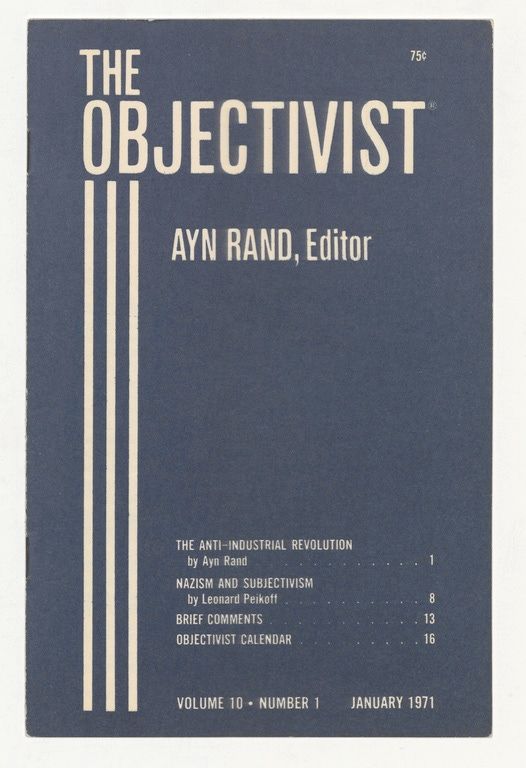
I was rather surprised when someone I have known in the Objectivist movement for forty years publicly proclaimed that he would no longer be calling himself an Objectivist. He reminded us that Ayn Rand herself asked that people refer to themselves as “students of Objectivism.” While I think it was respectful and proper to do that during her lifetime, this is a rather cumbersome formulation. We should all be lifelong learners, but at some point I think it’s fine to recognize that you have integrated the fundamentals of a philosophy and can call yourself an adherent to it.
As I have stated elsewhere, no one is or can be a gatekeeper to a belief system. Literally hundreds of millions of people call themselves Christians without adhering to most (if any) of the teachings of Jesus Christ. The same is true with Islam, and every other belief system on earth. So it shouldn’t be a surprise that it is also true of Objectivism.
Concepts do have an identity. Belief systems do have principles and doctrines that define them. And we, as thinking, conceptual beings, must constantly judge our fellow human beings. Judging them by their self-proclaimed labels is problematic, not only because people can lie to us, but because they can and do lie to themselves. None of the Christians I know practice what Christ preached — it would be impossible to do so and continue to live. But I still consider them Christians if they are earnestly (if mistakenly) attempting to live out what they see as his core teachings (kindness, humility, etc.) However, I don’t spend much time evaluating Christians because even the best of them have a mistaken belief system that is not of much use to me in maximizing my life and happiness.
On the other hand, Objectivists (or students of Objectivism, fans of Ayn Rand, etc.) have been an integral part of my adult life, not only intellectually and professionally, but socially. So for me, there is utility in determining who truly understands the philosophy — and who doesn’t. It doesn’t mean that a non-Objectivist cannot offer value to my life. On the contrary, my top value, my husband, is not an Objectivist. I have learned and continue to learn much about the world from him and many other non-Objectivists. But if I want to expand my understanding of Objectivism, it’s important for me to learn from people who actually understand the philosophy. So I do need to judge them on that basis. I am not casting people out. I do not even “unfriend” people based on whether or not I think they are Objectivists. But the philosophy has a specific meaning, and yes, I get to use my mind to decide who is an adherent to that philosophy. So what is Objectivism, and who do I think qualifies as an Objectivist?
Contrary to what I am often accused of, I don’t think you need to vote a particular way, or support (or oppose) a specific piece of legislation in order to be an Objectivist. But you need to believe in, and try to practice, its core beliefs. What are those beliefs? Ayn Rand once was challenged to state the essentials of her philosophy “while standing on one foot.” Here’s what she wrote:
1. METAPHYSICS: OBJECTIVE REALITY
or “Nature, to be commanded, must be obeyed” or “Wishing won’t make it so.”
Reality exists as an objective absolute—facts are facts, independent of man’s feelings, wishes, hopes or fears.
2. EPISTEMOLOGY: REASON
or “You can’t eat your cake and have it, too.”
Reason (the faculty which identifies and integrates the material provided by man’s senses) is man’s only means of perceiving reality, his only source of knowledge, his only guide to action, and his basic means of survival.
3. ETHICS: SELF-INTEREST
or “Man is an end in himself.”
Man—every man—is an end in himself, not the means to the ends of others. He must exist for his own sake, neither sacrificing himself to others nor sacrificing others to himself. The pursuit of his own rational self-interest and of his own happiness is the highest moral purpose of his life.
4. POLITICS: CAPITALISM
or “Give me liberty or give me death.”
The ideal political-economic system is laissez-faire capitalism. It is a system where men deal with one another, not as victims and executioners, nor as masters and slaves, but as traders, by free, voluntary exchange to mutual benefit. It is a system where no man may obtain any values from others by resorting to physical force, and no man may initiate the use of physical force against others. The government acts only as a policeman that protects man’s rights; it uses physical force only in retaliation and only against those who initiate its use, such as criminals or foreign invaders. In a system of full capitalism, there should be (but, historically, has not yet been) a complete separation of state and economics, in the same way and for the same reasons as the separation of state and church.
FINAL THOUGHTS
If you held these concepts with total consistency, as the base of your convictions, you would have a full philosophical system to guide the course of your life.
And, I would add, you would be an Objectivist.
The tricky part, of course, is in implementation — in actually achieving that consistency. Make no mistake, thinking deeply and philosophically is hard, and it would be foolish to expect people to be perfect at it, or to always agree with each other. Within each of these core tenets, I think there is room for debate and discussion. I would even say there is a range of consistent implementation (there might not always be only one right answer). That said, it is a fairly narrow range, and obviously cannot encompass contradictions.
In metaphysics, Objectivists can disagree on how to interpret data from esoteric physics experiments. But we cannot simply ignore or dismiss data because it doesn’t fit our preconceptions.
In epistemology, we can disagree on how best to get our information, on which news sources are reliable. But we cannot accept information on faith. We cannot accept the word of a government spokesman when it contradicts the evidence of our own eyes.
In ethics, we can decide who is worthy of our compassion or our charity. But we cannot treat people as less than human, as anything other than individuals who are ends in themselves and have a right to exist for their own sake.
Politics, particularly the details of how to move from a mixed economy to actual capitalism, is where I think there is the most legitimate room for differing views. In a perfect world, I believe everyone should have complete freedom of movement (as long as they are not violating anyone’s rights, obviously). But we are very far from that world, and there are well reasoned arguments that can be made for regulating the border to prevent rights-violators (especially terrorists) from entering. What an Objectivist cannot do, though, is decide that some people, based on where they were born, do not have the same human rights that we all have (because rights are derived from man’s nature, not his nationality). We cannot advocate for doing away with due process or other constitutional protections because they make enforcing laws more difficult. We cannot compromise on the need for objective law (which Rand defines quite explicitly) and claim to understand or advocate for Objectivism.
I think there are a lot of people making serious mistakes as they try to apply Objectivism. Many are trusting news sources that are not trustworthy. They are giving the benefit of the doubt to politicians who don’t deserve it, and demonizing groups of people based on the actions of a fringe few. I may have strong disagreements with these people — and still consider them Objectivists. But I’m sorry, if concepts have any identity at all, you cannot be an Objectivist if you have abandoned any of the philosophy’s core tenets. Just as there can be no Christian Objectivists (although some continue to maintain that’s what they are), there can be no ends-justify-the-means Objectivists. There can be no “comply or die” Objectivists. There can be no only-citizens-have-rights Objectivists.
As I’ve said, I am not the thought police. I have no power to cast anyone out. But I do have the responsibility of judgment. And so have you.
So when I see certain people refer to themselves as Objectivists while simultaneously applauding masked government thugs shooting people down in the streets with impunity, I can’t help but recall that classic line from Inigo Montoya (written by screenwriter William Goldman) in The Princess Bride, “You keep using that word. I do not think it means what you think it means.”