Thoughts on the War

Right before the current war/“major combat operations” against Iran was launched, I laid out my thoughts on what would be needed for me to fully support such an action. Now, in the third week of hostilities, I think it is worth doing an evaluation.
My first condition for support was that “Trump clearly states that our goal is to remove the current regime, and executes a plan that works to achieve this goal.” As is so often the case with Trump, you can cherry-pick statements that support just about any position. So you can find a quote where Trump says we need to remove the current regime. But you can also find statements where he (and others within the administration) deny that regime change is the goal. In either case, if Trump is executing any kind of clear plan, he is failing to communicate what it is to the American people. Instead, his approach seems almost entirely whim-driven, as when he states the war will be over when “I feel it in my bones.”
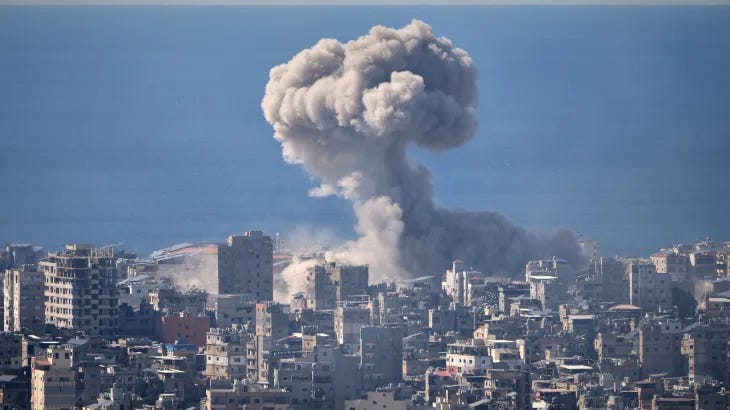
I think that there have been impressive triumphs for the U.S. in this conflict (even Al Jazeera acknowledges this), but if the administration can’t articulate proper goals and strategies, it’s hard to be too optimistic. Trump’s general unseriousness also undermines the hope that he can be an effective commander-in-chief. When he tells us that US strikes “totally demolished” most of Kharg Island, but that the military may hit them “a few more times just for fun,” he makes it sound like this is all a game to him. It most certainly is not a game to the people of Iran, or of Israel, or for many Americans (particularly those in the armed forces). Yes, we have overwhelming military superiority over the Iranians. But that is no guarantee of victory — a lesson we should have learned from Vietnam over 50 years ago, if not more recently from our loss in Afghanistan.
My second condition was that “Any military action must keep risk to US troops to the barest minimum.” This one is harder to evaluate. There have been about 200 soldiers wounded to date, with 13 deaths. That is tragic and my heart goes out to the families of our lost service members. But as wars go (if this is indeed a “war,” another subject on which this administration can’t seem to agree), this is not a huge number. Yet. Of course, the conflict isn’t over and the Iranian regime, unfortunately, does not seem to be in serious danger of falling. It’s not at all clear that regime change can be achieved without landing troops. Last week, Trump told the New York Post, “I don’t have the yips with respect to boots on the ground — like every president says, ‘There will be no boots on the ground.’ I don’t say it.” If we do end up sending troops into Iran, casualties are likely to mount up quickly.
My final condition was that “Congress authorizes what is clearly a military action.” This, of course, did not happen. Nor did I expect it to, given that Congress has been happy to relinquish its constitutional role ever since the end of World War II. For the future of the republic, Congress needs to step up and again become a co-equal branch of the government. However, given the quality of the politicians we have today, I understand how unlikely this is. If Trump were a better leader and were executing this war properly (and for the correct and explicitly-stated reasons) I would not harp on it. Not because the principle isn’t important, but because eliminating Iran as a global threat is also important. And because while I decidedly do not believe in pragmatism, I do believe that we can’t let the perfect be the enemy of the good. I still wish Trump had done this the right way — and think he should certainly be criticized, especially now that he is asking Congress for $200 billion to conduct a war they had no say in starting — but I don’t think the remedy is to demand that we simply call the whole thing off.
Iran has been a threat to the U.S. (as well as to Israel and the West) since the regime took our citizens hostage in 1979 and began referring to us as “The Great Satan.” And yet, it is hard to argue that Iran was an imminent threat (especially since Trump maintains that we destroyed their nuclear capabilities back in June). If it were posing such a threat, nothing the administration has told us supports it, other than that Trump had “a feeling.” Since the threat seems to be ongoing rather than urgent, there are a number of smart actions that should have been taken before launching this war:
Knowing how vulnerable the Strait of Hormuz is, we should have lined up allies in advance to ensure that shipping lanes could not be closed down.
Knowing that oil supplies were inevitably going to be impacted, we should have gone into this with our Strategic Oil Reserves at 100% (instead, they were only at about 60%).
Knowing that regime change would be difficult without some kind of “boots on the ground,” we should have had plans in place (perhaps with the Kurds) to bring support and weapons to the anti-regime forces within Iran. Although the regime seems to be pretty unpopular, the opposition does not have arms and struggles even to communicate with each other.
Unfortunately, none of that happened.
I think most Americans (including many Republicans) believe that Trump is flying by the seat of his pants — as usual. Without a well thought-out plan or strategy (or even criteria) for victory, I fear that at some point Trump will cave to internal and international pressure. He will then declare victory and withdraw from Iran, leaving the current regime injured and angered but intact. Am I not giving Trump enough credit? Time will tell.
The fact that Trump seemed surprised that Iran was able to (mostly) close the Strait of Hormuz, and that he then began pleading with allies to help keep it open, indicates that attacking Iran was not a rare exception to his long history of acting impulsively. While good things can sometimes come out of poorly thought-out actions — and I very much hope they do in this case — bad things inevitably come as well. Higher oil prices are going to cause economic hardships, possibly even triggering a global recession. Even worse (possibly) is that higher oil prices — and now a lifting of sanctions — are going to benefit Russia. And a stronger Russia is most definitely bad for America and for the West. All this might be a worthwhile price to pay for eliminating the threat of a militant Iran. But if the regime is only weakened? Then it’s likely we will have lost more than we have gained.
Make no mistake, the Iranian regime is murderous and is a threat to America. It should have been stopped long ago. We have never been this close to toppling it, and it would be a travesty to those whose lives have been lost to stop short now. I just wish that the people conducting this war (or whatever euphemism we’re using) were remotely competent or able to think and plan long-range. I’m no fan of Netanyahu, but I do have a lot of respect for the Israeli military and can only hope that they have done some of the thinking and strategizing that Trump seems unable to do. Real victory may be achievable, but clearly it’s not going to be as easy as Trump imagined. However ill-advised it may have been to launch this military action when and how he did, it would be a mistake to have come this far and not finish the job. Unfortunately, knowing what we do of Trump’s character, I think that is the most likely outcome. I hope I’m wrong.
Call me a hawk if you want. Like many Mexicans and people worldwide, I believe the Iranian regime must be decisively confronted and dismantled. Durable peace has never arrived without force, and the coming order will be no different. I really reject the fantasy that peace emerges without coercion. History shows otherwise. I support decisive action against the Iranian regime—not its people—and restore deterrence. Moral outrage alone doesn’t end regimes; power does.
The question isn’t whether power will be used, but whether it will be used to end a system built on terror.
There is no way to remove the IRGC without a ground invasion. They are too entrenched. Can't be done. This was well understood long before we attacked. They control a significant portion of Iran's economy through direct ownership of businesses. It has its own intelligence apparatus. It has judges, police, parliamentarians and religious entrenchment in Iranian society. The militia is woven into neighborhoods across the country. The fact is, more than 40% of Iranians still approve of the regime as-is.
There are really only two choices:
1. Ground invasion. The American people do not have the stomach for the body bags, and they would be many. It would make Afghanistan look like an accident going over a speed bump. There wouldn't be a clear end goal, just as there wasn't in Afghanistan (for reasons stated above). Occupying the whole country doesn't change the will of the people, in fact, it can polarize it against you.
2. Withdraw, claiming victory while leaving the IRGC and the regime in place. This is the advantage of not declaring an objective--you can claim your objective is accomplished at any time.
The route he seems to be going is making up his own option 3: Arm wrestle more countries into pressuring the regime without a ground invasion, which won't remove the IRGC or topple the regime either.
There are a lot of nuanced outcomes riding on which side of the bed he wakes up on tomorrow. Nuanced, but severe and world altering. Will the marines in the Tripoli strike group seize Kharg Island? The short term effects would be great for us. The long term effects would be devastating.
The problem is that I don't know if Trump cares about the long term effects, and I don't think anyone else knows either. I've even got doubts that he knows.