
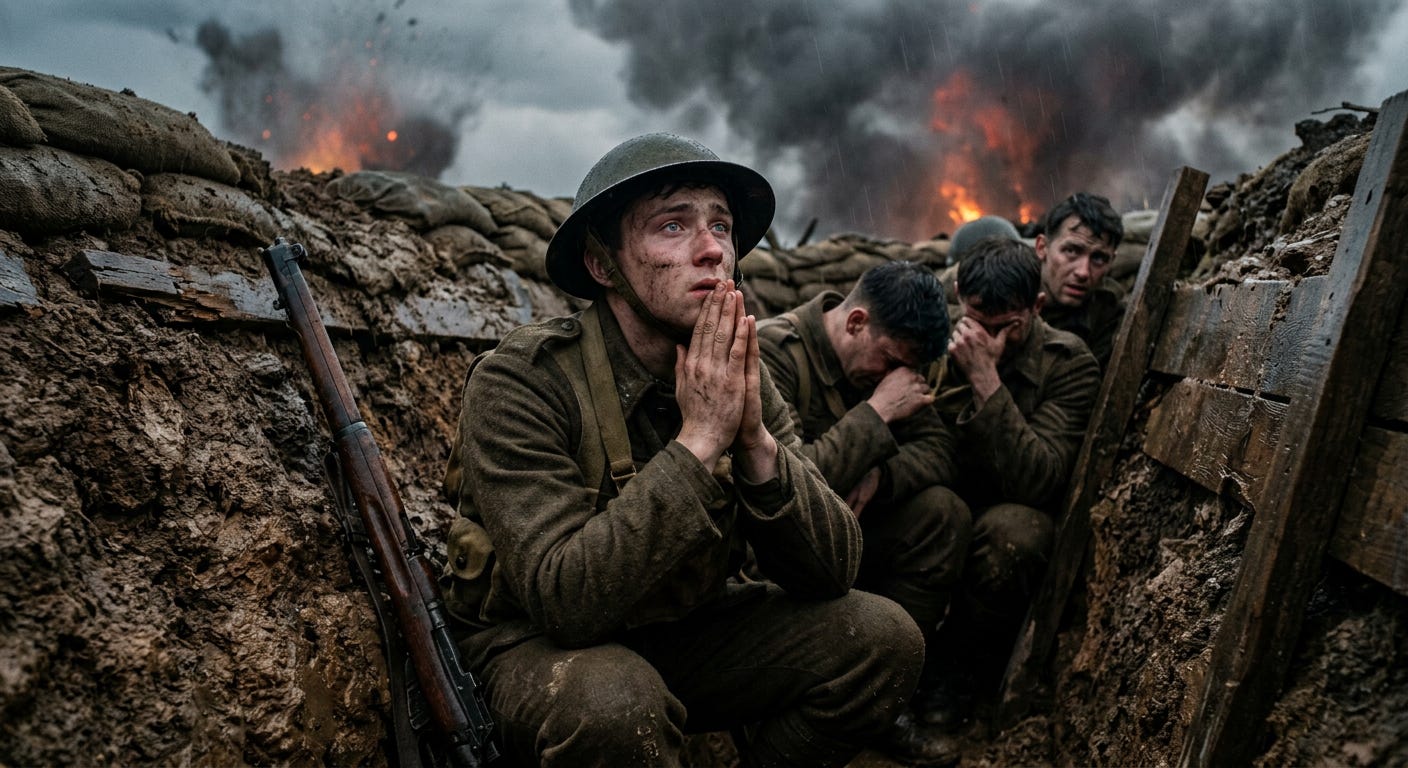
We’ve all heard the saying, “There are no atheists in foxholes.” This is a catchy phrase with a kernel of truth (people are more likely to fall back on a belief in god in stressful situations), but the reality is that many atheists in combat situations continue to not believe in god. While it is true that only a small percentage of military personnel (about 3%) consider themselves to be atheists, this figure is similar to the rate of atheists found in the general population. In other words, atheists are found in foxholes at about the same rate as they’re found anywhere else.
A much more accurate saying would be: there are no atheists in prison. Self-identified atheists make up a very small fraction of the prison population (about 0.07% to 0.10%) — far less than in the general population. Religionists try to tell us that there can be no morality without a god, but the data don’t support this. In fact, those without a belief in god seem to be less likely to commit crimes.
Of course, non-belief in god tells us nothing about what a person does believe. An atheist can be a nihilist, or a hedonist, or think that might-makes-right. In other words, atheists can still be bad people. What they don’t believe, though, is that their bad deeds will be magically redeemed, or that this life is but a prelude to a much more important afterlife.
A morality built on moral commandments and obedience to authority — even if the precepts of that morality are correct — is inherently less robust than one derived by using one’s own mind to determine the requirements of man’s life here on earth. Ayn Rand wrote that “….an error made on your own is safer than ten truths accepted on faith, because the first leaves you the means to correct it but the second destroys your capacity to distinguish truth from error.”
Criminals, and unfortunately far too many others, view morality as something separate from themselves. They see it as a list of rules imposed from outside, rather than a guide for living which they must discover and integrate in order to be happy and successful. A man is far more likely to go against a commandment or moral precept that he’s accepted on faith, because he doesn’t understand how following the moral idea is actually in his self-interest. Of course, if he’s accepted erroneous ideas, then following them may not be in his self-interest either. But a proper morality is one that allows individuals to thrive. And discovering the principles of morality, rather than blindly accepting precepts handed down from authority figures, is far more likely to guide and comfort you, whether in foxholes or in more everyday situations.
Of course, people can and do evade. Unfortunately, even Objectivists sometimes evade their hard-won knowledge of what is right and wrong. We were all raised in a world of mixed premises, usually by people with mixed premises, and many of us have psychological and even psychiatric issues to contend with. We are not brains in vats, carrying out rational calculations. Emotions are powerful drivers of behavior. I would venture to say that behind most immoral actions are emotions which have not been properly examined and integrated. So, rejecting religion doesn’t guarantee that you’ll find and practice the right morality. But accepting religion, i.e., taking moral precepts on faith, is always a mistake.
Perhaps that is why national prosperity and personal religiosity show a strong negative correlation, and even within the U.S., the Bible Belt generally lags behind the rest of the country in such measures as median household income, poverty rates, and educational attainment.
If belief in God led to happiness and prosperity, the period after the fall of Rome and before the Renaissance and Enlightenment would be thought of as a Golden Age. But despite attempts to rebrand the Dark Ages, it earned that moniker by being a time of stagnation, oppression, and misery. That is what faith leads to when practiced consistently. Thank goodness few in modern societies do. The fact that J.D. Vance and others Republicans want us to should be seen as a big, clanging alarm. For a thousand years, we ran the experiment of letting faith rule the world. Much of the Islamic world is conducting a similar experiment now. If human flourishing is the goal, such “experiments” are disastrous.
A free country must have freedom of religion, but much more importantly, it must have freedom from religion. The separation of church and state is not just a foundational principle of our republic, but a necessary precept for any free society. Unfortunately, Trump, Vance, and other Republican politicians want to erode that wall of separation. Earlier this year, Trump said, “We’re bringing back religion in our country, and we’re bringing it back quickly and strongly—because for America to be a great nation, we must always be one nation under God.”
As usual, Trump has it almost exactly backwards. It was the secular nature of our nation that made America great. It was by rejecting the religious in-fighting that had crippled Europe for so long that America was able to create a multi-ethnic, multi-religious (and non-religious) state centered on the common belief in individual rights, not the existence of any particular deity.
On the bright side, despite the rise of the Religious Right, Americans in general have been getting steadily less religious over time. This knowledge is part of what drives Republicans to attempt to force religion down our throats. They are losing in the battleground of ideas, so they are moving the fight to the political realm. Don’t let them.
There are atheists in foxholes, and there should be atheists in politics and every aspect of civic life. Yearning to bring back that old-time religion is a thinly veiled attempt to bring back authoritarianism. Remember, God rarely speaks directly to people (and certainly not to you). You are supposed to know his will by trusting his representatives on earth. Because of this, organized religion is by its nature authoritarian. Religionists think they have the moral high ground. They don’t. We must never forget that the moral high ground is held by the individual using his own mind to determine right and wrong.
People “of faith” can be good people. The recent death of Dolly Parton reminded me of this. But they are good not because of their faith, but largely in spite of it. They are good to the extent that they actually use their minds to make good choices, rather than mindlessly following what their minister or priest (or mullah or rabbi) tell them. They would be even better people if they took the bold step of rejecting faith entirely.
Unfortunately, despite the declining religiosity of Americans, most people are not about to reject faith and embrace reason. But I do think they understand, at least at some level, the necessity of keeping faith out of politics. At least, I hope so. If Republicans succeed in tearing down the wall of separation between church and state, it will be a very bad thing not just for atheists, but for everyone.
Brilliant article. Thank you!
Great writing. My son is a Marine. I raised him not to think in terms of sacrifice.