Eat the Rich?

Wealth taxes, in various forms, seem to be the latest craze in Democratic politics. Of course, “eat the rich” is actually a very old idea — and not a good one.
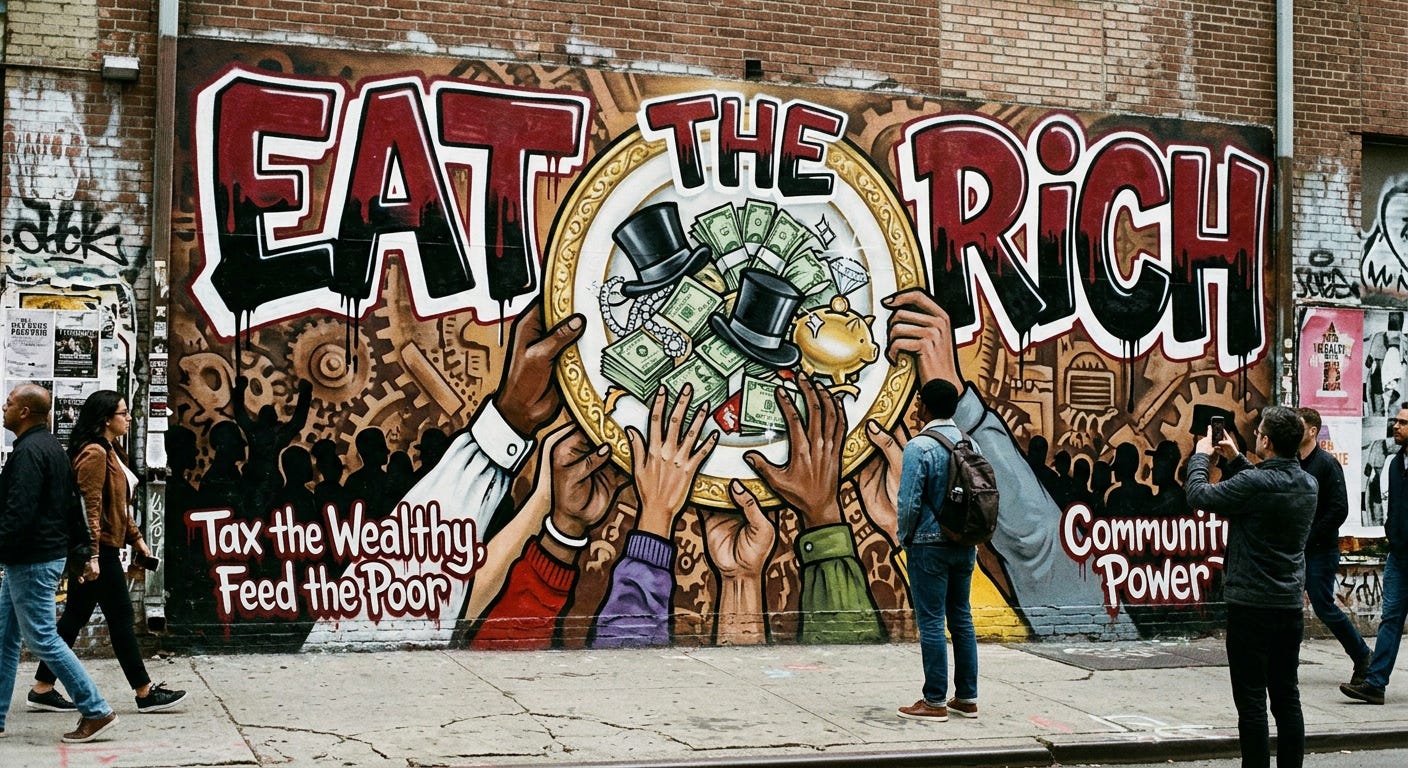
In California, the “Billionaire Tax Act” has been approved for the November 2026 ballot. If passed, it would institute a one-time 5% tax on net worth exceeding $1 billion.
In New York, Mayor Zohran Mamdani is targeting ultra-wealthy residents and major corporations with proposals that include a city-level personal income tax increase, a special tax on second homes, and corporate tax “reform.”
Federally, the Ultra-Millionaire Tax Act has been re-introduced by U.S. Representatives Pramila Jayapal and Brendan Boyle, alongside Senator Elizabeth Warren. This legislation would create a 2% annual tax on the net worth of households and trusts valued above $50 million, plus an additional 1% surtax on net worth above $1 billion (totaling 3%).
Of course, it’s not clear which if any of these proposals will be enacted, but the hostility towards the “ultra-rich” right now is palpable. Ayn Rand wrote extensively and eloquently about “hatred of the good for being the good” and also specifically about the vilification of businessmen. So, while hardly new, I do think this sentiment is intensifying, and is likely to result in at least some of these proposals (and others like them) being passed.
From an economic perspective, it doesn’t make sense to penalize our most productive citizens. I am even more opposed to it from a moral standpoint. Property rights mean that people should keep what they earn. That said, even a proper government needs to fund itself (though the funds needed would be orders of magnitude less if government carried out only its proper functions). In the absence of an Objectivist utopia where voluntary ways of funding the government have been established, there will be taxes. But given that, they should be kept as low and as fair and as simple as possible. That’s why I think a flat tax of some kind (perhaps along the lines proposed by Steve Forbes) probably makes the most sense. Of course, that is not being considered, and instead we’re getting this concerted effort to increase taxes on the wealthy. And given the mess the Republicans are making of the economy, the Democrats have a good chance of passing many of these laws.
Make no mistake, the driving force behind these soak-the-rich schemes remains the envy that has long been stoked by socialists and the Left in general, and more recently has been a tool of MAGA and the nationalists. But there are other factors, stemming from more benevolent motives, that I suspect will drive many center-Left and even center-Right voters to support these kinds of initiatives.
Objectivists are sometimes the only people championing entrepreneurs and businessmen, i.e., the creators who move the world forward. Ayn Rand did such a magnificent job of presenting this type of character (especially in Atlas Shrugged) that it’s easy to forget they are fictional, and that in the real world, rich people are rarely as unproblematic as Hank Rearden or Dagny Taggart. Rand herself created excellent examples of rich villains who did not earn their wealth such as James Taggart and Orren Boyle. And unfortunately, in the real world — in our highly mixed economy — there may be more James Taggarts than there are Dagnys. Many of the world’s richest people — including our president — have gained their wealth at least in part through cronyism, government favors, or outright dishonest means (Trump is notorious for not paying people for the work they’ve done for him). Wanting to see these people taxed at a higher rate for their ill-gotten gains is closer to an impulse towards justice than an example of envy (although both factors can simultaneously be at play).
In today’s context, a rational person simply can’t pretend that all wealth is achieved by productive means. Many Objectivists seem to think that Elon Musk is a productive genius, but there’s no denying that a substantial portion of his wealth has come from government favors and cronyism. And when he spouts off on X or on The Joe Rogan Experience about various topics, he certainly doesn’t seem like a genius. In fact, to anyone who knows anything about science, his “plans” for a city on Mars are not ambitious—they are delusional! He comes across like a profoundly damaged man with a bizarre mix of good, bad, and stupid ideas. He is certainly no John Galt. And when you look at what he “achieved” when he ran DOGE, it is even harder to credit the notion that he is any kind of genius.
And then there’s Donald Trump. In the first year of his presidency, his net worth has increased by $3 billion due to a mix of sweetheart deals, insider trading, and various crypto-currency schemes. Forbes magazine says, “No president in U.S. history has used his position of power to profit as immensely as Trump.” Many of Trump’s friends and supporters (and of course, his family) have similarly benefited. When corruption is this open, it’s hardly surprising that public sentiment towards the rich is increasingly hostile. We should all be hostile towards this kind of wealth accumulation.
When virtually nobody other than Objectivists (who unfortunately have little influence in the public sphere) understands the profound virtue of wealth creation, it is no small wonder that taxing the rich seems like a good idea. I don’t think we’re going to get anywhere in fighting these proposals until and unless we can make people see the difference between creating wealth and acquiring it by grift and government favors. Ultimately, what we need is a complete separation of state and economics, along the lines suggested by economist Raymond Niles — but there’s no political will on either side to even move in that direction.
The other part of this package deal that these proposals represent is recognition of the fact that we cannot simply continue to borrow money indefinitely to fund the government. The U.S. national debt increased almost $2.3 trillion last year, bringing the gross national debt to roughly $38.4 trillion. Trump is now responsible for around 20% of the total national debt! One of the “achievements” that his supporters cite is that Trump has lowered taxes. But lowering taxes while increasing spending is NOT an achievement and in fact is not truly lowering taxes. It is shifting them forward in time, to burden our children and grandchildren. Since neither political party seems willing or able to actually cut government spending, increasing taxes is the only viable strategy for remaining solvent (other than inflating the currency, which is damaging to the economy as well as politically dangerous).
When people like Trump and Musk acquire almost unimaginable wealth through cronyism and inside dealing, it’s a tough sell to convince the average worker that he (who is struggling with credit card debt and increasing prices for gas and food) is the one who should pay more in taxes. If we’re going to have to raise taxes (and I don’t see how we avoid it unless we massively curtail government spending), then it actually makes both economic and moral sense to tax the James Taggarts and Orren Boyles of the world.
Unfortunately, I don’t know of a way to separate these miscreants out and only tax them, while leaving the Hank Reardens untouched. So, sadly, I think we’re likely to suffer through a wave of various new taxes on “the rich,” which is likely to shift productive capital into government coffers and slow down our already sluggish economy. It’s especially sad because such measures are akin to placing a bandaid on a patient who is bleeding out. Any real solutions to our economic problems would require a massive shift in our thinking about the proper role of government—and that is still a long way off.
In the meantime, it would be great if some smart, free-market economist could figure out how best to increase tax revenue while minimizing damage to our actual wealth-creators. It would also help if we would start cracking down on the kinds of grift and special favors that have so enriched Trump and his pals. Maybe a combination of these strategies could buy us the time we need to spread the right economic and moral ideas that would truly turn things around? I’m not terribly optimistic, but on the other hand, there are some amazing productive geniuses in the world, working in fields like AI, robotics, and biotech. If we can avoid squelching them entirely, maybe they will, despite the hostility and envy they face, keep this sinking ship afloat by the sheer wealth creation they bring about. If anyone can save us, it certainly won’t be the politicians (of either party); it will be the innovators.
You are totally right. It is clear to everyone that rising taxes have never end up in a long-term decline in fiscal deficits —actually, the opposite. The more money thieves get from you, the more money they want.
Objectivists worship entrepreneurs, though many of them have enriched themselves through immoral means. This is even worse as our mixed economies have grown into full socialized economies. I understand that decent entrepreneurs must enter questionable deals with politicians, but others thrive decisively on corruption and favor. It is time for objectivists do a more nuisance critic of entrepreneurs and entrepreneurship.
Once you concede a forced payment ( taxation) you open the door to an endless stream of continuance and expansion. Compromise with evil only encourages it.