Does Capitalism Need a Makeover?

Over the many years that I’ve been involved with the Objectivist movement, I’ve heard a number of debates on whether Ayn Rand should have used the word selfishness to describe the core of her ethical system. Some think it would have been better to say rational self-interest. Others think using the provocative term was not only correct, but was actually good marketing — it caught people’s attention in a way that “rational self-interest” never would have.
But I don’t think I’ve ever heard Objectivists having the same kind of debate over the word capitalism — and I think maybe it’s time we did. Rand, of course, published a book called Capitalism: The Unknown Ideal, explaining what she meant by the term and why it exemplified her ideal political system. But whereas I think selfishness captures the essence of her ethics, I don’t think capitalism is similarly ideal in this regard. If one were just speaking of an economic system, then perhaps it would make sense to center it around the concept of capital — which is indeed a key component. But as conceived and explained by Rand, her meaning is more broadly political, not merely economic. It centers around the idea of individual rights and each individual’s freedom to use his mind to pursue his own selfish goals and produce what he needs to thrive in the world. The vast majority of people benefiting from this system may never have much in the way of “capital.” They may never own a factory — or even their own home. But it is their freedom to do so — to trade voluntarily with others and to keep what they have earned — that makes this a moral social system, far better than any other so far devised.
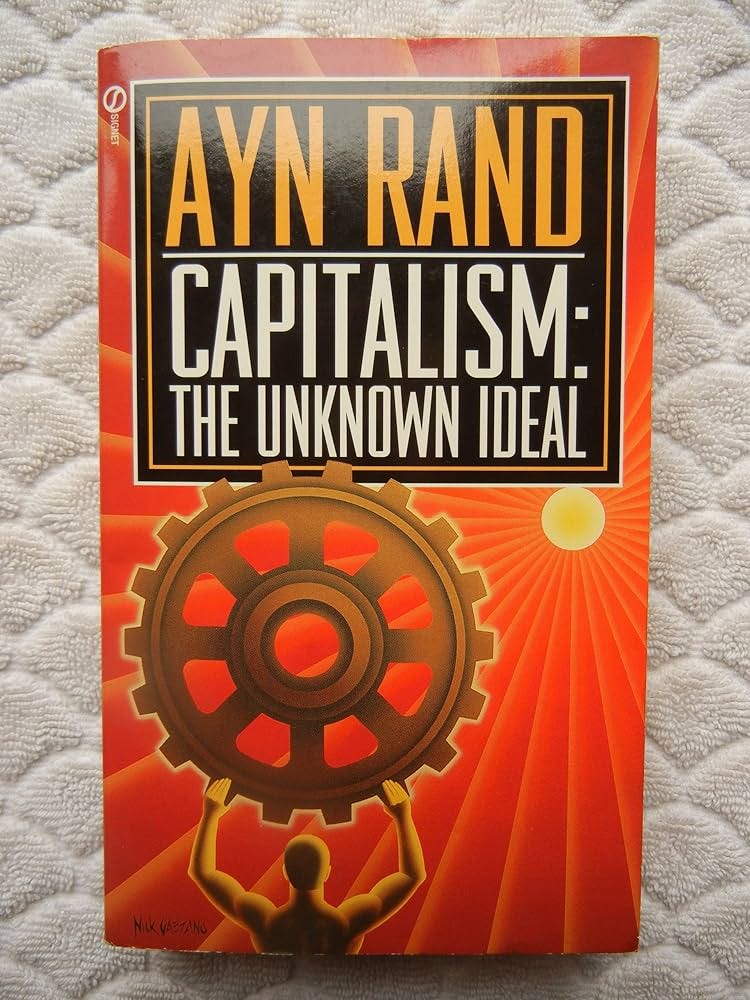
In the laissez-faire system as conceived by Rand, capital is able to find its most productive use and society as a whole becomes vastly wealthier. But her argument is not utilitarian (that case has been made by many others — sometimes brilliantly). Rand’s distinctive contribution was to show that capitalism is moral. It is right and good because it allows individuals to thrive (or to fail) based on their merits, and because it implicitly recognizes the role of the mind and of volition in human flourishing. Yes, it allows big business to innovate and the economy in general to thrive. But it does this by allowing each individual to act in whatever way he wishes, so long as he’s not using force (or fraud) against anyone. This benefits even those who claim to hate the system. In a truly capitalist society, if you want to work in a factory owned by the workers, you are free to find others with the same goal and start up such a factory. You think people should live communally and share all their resources? You are free to join or to create a commune and see how that works out for you. You just aren’t “free” to force others to join with you.
It is this absence of force, rather than the presence of capital, which is the fundamental of the system. That is very far from what we have now. And unfortunately, Trump — with his tariffs, his price controls, his government stakes in private companies — is leading us further and further from anything Rand would have recognized as capitalism.
Unfortunately, Rand’s “ideal” social system is even more unknown now than it was in her time. In the popular imagination, Trump has become an emblem of capitalism. This fallacy is promoted by his supporters and detractors alike! As a result, I fear that the word may be beyond redemption (at least in the foreseeable future). But the name is not synonymous with the concept, and the concept of capitalism is still very much an unknown and untried ideal. So rather than spend the next several decades trying to undo the damage that has been done to its good name, why not rebrand it? Why not come up with a term that does not carry the baggage now associated with capitalism? And while we’re at it, maybe that new term could actually be more descriptive of capitalism’s nature as a political (not just an economic) system? I’ve heard some use the term Voluntarism, but I think that’s too broad and too easily confused with anarchy. “Freedom-from-Force”ism obviously doesn’t work. But clunky as it is, I think it more accurately describes the social system I’d like to see, with a limited but strong government whose sole purpose is wielding the use of retaliatory force in response to the initiation of force, all according to objectively defined laws. I believe young people (who currently have negative opinions of capitalism) might want to learn more about such a system.
I’m not a marketer. I have a hard enough time coming up with catchy titles for my Substack posts, so I don’t know that I’m the best person to coin a new term for capitalism. But I do think maybe we need one if we want to start moving towards a freer economy in my lifetime. Suggestions, anyone?
Defending capitalism explicitly on moral grounds is well and good but in my experience it is more effective to say that capitalism is not essentially an economics phenomenon at all. It takes place in the context of producing, exchanging and using goods and services but that doesn’t make it essentially economics any more than the question of whether you ought to go to BED with the flu is essentially a question about furniture. No, it’s essentially about your health. And capitalism is essentially about how we live together, get along, and treat other people in a certain area of human affairs, namely, producing, exchanging and using goods and services.
“It is this absence of force, rather than the presence of capital, which is the fundamental of the system.”
That’s a negative focus - something it’s not.
Concretizing it as property rights and what that requires is an excellent way to make it understandable.
I must also add that I always like your writing Stewart.